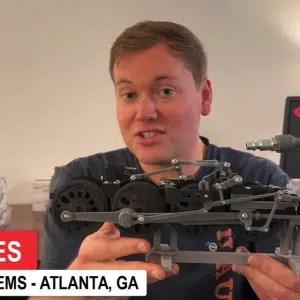
Hello, everyone! Today, we’re diving into a thrilling project that brings together history, engineering, and modern technology. Imagine taking one of the most powerful machines ever built and transforming it into a 3D-printed marvel that can run on compressed air. This journey began not just as a hobby but as an educational adventure, showcasing a step-by-step process from learning to creating.
The Genesis of an Idea
In today’s blog, I’m stepping in front of the camera to share a unique endeavor I’ve embarked on. If you’re here, you likely already know that we’re embarking on a 3D printing project—and not just any project, but one inspired by the mighty steam locomotives of the past. The spark for this journey ignited during a 3D printing training course I attended.
During this course, we were introduced to the essentials of parametric modeling, using customized exercises that included bottom-up assemblies. My goal was to refresh the model used in these exercises with something more dynamic and compelling. For those familiar with steam engines, you’ll understand the irresistible allure of their complexity and historical significance.
Becoming Enlightened
Like many great projects, this one took an unexpected turn when I stumbled upon an inspiring model by Arrowcoy on YouTube. This discovery sparked the imagination: What if my 3D-printed steam engine assembly could be powered with compressed air? This led to an immersive design phase, where I planned and reimagined the engine to bring it to life.
Digging into Details
Choosing the right locomotive as a basis was crucial. The Baker valve gear used in Arrowcoy’s model suggested a starting point—the Berkshire class engine, known for its distinctive design. Baker valve gear systems, alongside the Wild Shirts Valve Gear, defined a generation of American steam locomotives, providing a unique challenge and ensuring my design wouldn’t simply mirror Arrowcoy’s work.
But which locomotive to choose? There was only one true contender, combining historical significance and sheer awe: the Union Pacific Big Boy.
The Union Pacific Big Boy: A Testament to Engineering
Standing as a testament to human engineering, the Big Boy is unrivaled in stature and legacy. Stretching over 132 feet and weighing in at a staggering 1.2 million pounds, this colossal machine was built for power. With the capability to generate 7,000 horsepower, the Big Boy hauled freight across the Wasatch Mountains, reaching speeds of up to 80 mph.
The locomotive’s immense scale, with eight sets of five-foot, eight-inch driving wheels and a coal requirement of 12 tons per hour, echoes through the history of American railways. Its role during World War II and its legendary status in railway history make it more than just a train; it is a cultural icon, embodying the spirit of innovation and endurance.
Crafting a Modern Marvel
Armed with an abundance of resources on steam trains, I embarked on transforming this giant into a manageable yet detailed 3D model. The goal? To capture the essence of the Big Boy while making it accessible for anyone to print and power using compressed air, making it both an artistic and functional piece.
Every aspect of this project has been guided by a deep respect for historical engineering while pushing the boundaries of what modern tools and technologies can achieve. By sharing this journey, I hope to inspire others to not only learn but to create, turning historic ideas into tangible realities today.
More in this Locomotive Webinar Recap
-
-
- Designing a 3D-Printed Steam Engine You Can Power With Compressed Air (Big Boy Inspiration)
- Designing Working Walschaerts Valve Gear in SOLIDWORKS: Validating Link Lengths, Lap & Lead
- Choosing FDM vs SLA for a 3D Printed Model: Stand Design, Part Planning, and Hardware Prep
- Crafting a G-Scale Replica: Designing the Iconic Big Boy Locomotive
- Designing and Testing Linkages in SOLIDWORKS: Clearances, Mates, and 3D-Printed Fit Checks
- Assembling a 3D-Printed Steam Engine Valve Gear: Fits, Clearances, and Iteration
- Why My 3D-Printed Steam Locomotive Kept Stalling (And How Quartering Fixed It)
-